Published
Youth Mentoring Gap Data:
Why It's Getting Worse (2026)
1 in 3 kids grows up without a mentor. That number is getting worse, not better. Here's the data, and why most orgs can't close the gap.
Thought Leadership

Chris Miller
Founder & CEO
When my wife and I adopted our four kids, one of the first things we did was surround them with support. Tutors, counselors, community programs, and mentors. Especially mentors.
The relationships our kids built with their mentors have been life-changing. Not in a vague, feel-good way. In a measurable, lasting way. The kind of impact that shows up in confidence, in school, in how they see themselves in the world.
So when I started working with some of the nonprofits that had supported our family, I assumed the mentoring pipeline was healthy. I assumed that kids who needed mentors were getting them.
I was wrong.
The Numbers Behind the Gap
The data on youth mentoring tells a story that should alarm anyone in this space.
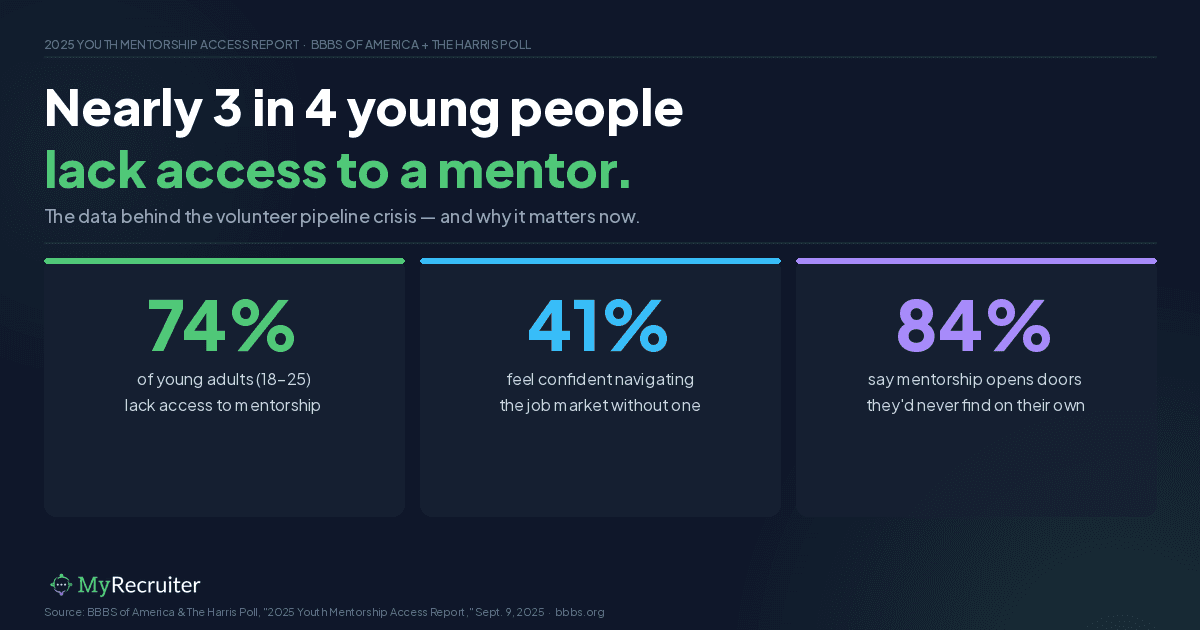
One in three young people in the United States grows up without a mentor (MENTOR.org, 2024). That alone should be enough to mobilize resources. But the trend line makes it worse: a September 2025 Harris Poll commissioned by Big Brothers Big Sisters found that 74% of Gen Z lacks access to a mentor (BBBS/Harris Poll, Sept 2025).
These are not small, declining numbers on their way to zero. They are large, growing numbers that reflect a systemic failure to connect willing volunteers with kids who need them.
And the impact of that failure is not abstract. Research from Harvard and the U.S. Treasury published in 2025 found that mentored youth earn 15% more over their lifetimes and are 20% more likely to attend college. The ROI of a single mentoring relationship pays for itself within seven years (Harvard/Treasury, 2025).
Our oldest son, who's now a junior in college, is a first-generation college student in his biological family. His mentor, who's also his life-long friend and an incredible CASA supervisor, helped give him confidence that he could go to college and succeed. He's going to graduate next year with a statistics degree in ML/AI.
The value is proven. The demand is massive. So where is the breakdown?
The Pipeline Is Broken
When I started talking to Executive Directors and Volunteer Coordinators at mentoring organizations across the country, a pattern emerged almost immediately. The problem is not that people don't want to volunteer. The problem is that the systems meant to convert interest into action are failing.
Here is what a typical volunteer journey looks like at most orgs today: a prospective volunteer finds a website, fills out a long application form, and waits. Days pass. Sometimes weeks. Eventually, someone from the org calls or emails to follow up. By then, the volunteer's enthusiasm has faded. They've moved on. They never hear back, or they've already committed their time elsewhere.
The data backs this up. Approximately 40% of mentoring matches close prematurely (Rhodes et al., study of 6,500 relationships). That means even when the pipeline does work and a kid gets matched, there is nearly a coin-flip chance the relationship ends before it should.
The upstream numbers are even harder to pin down because most orgs don't track them. How many prospective volunteers visit your website and never complete the application? How many complete the application and never hear back within 48 hours? How many start the process and quietly disappear?
If you don't know the answers to those questions, you don't have a volunteer recruitment strategy. You have a volunteer recruitment hope.
The Waitlist Problem Is Real
The consequences of a broken pipeline show up in waitlists. And the waitlists are staggering.
CASA, the Court Appointed Special Advocates program, saw its volunteer base drop from approximately 97,000 in 2019 to 79,000 in 2023 (CASA annual reports). That is an 18% decline in four years.
In Adams and Broomfield counties in Colorado, 280 children are currently waiting for a CASA advocate (Jan 2026). In Central Virginia, CASA reported that 223 children were never matched in FY2025, and the waitlist grew from roughly 60 children in 2019 to 139 by December 2025.
These are not abstract statistics. Each number is a child in the foster care system who has been assigned a case but has no one outside the system advocating specifically for them. Every day on a waitlist is a day that child goes without that relationship.
Why Traditional Approaches Can't Keep Up
The nonprofit sector is under enormous strain, and volunteer recruitment is one of the places where that strain shows up most clearly.
Nonprofit employee turnover sits at roughly 19%, nearly double the 12% rate in other sectors (Mission Edge, Mar 2026). Meanwhile, 59% of nonprofit employees say they plan to leave their current role within a year (Candid/Nonprofit HR, 2024/2025). The people responsible for recruiting, onboarding, and supporting volunteers are themselves burned out and leaving.
Layered on top of that, 62% of nonprofits report volunteer recruitment as a top organizational challenge (Double the Donation). This is not a new problem. But the traditional tools being used to solve it, long PDF applications, manual email follow-ups, spreadsheet tracking, are not scaling.
Consider the math. If a Volunteer Coordinator is managing 50 active volunteers, fielding new inquiries, running background checks, coordinating training sessions, and tracking compliance documentation, there is no realistic way for that person to also respond to every new inquiry within hours. The work simply exceeds the capacity of a single human.
And yet speed matters enormously. In a world where people can sign up for a rideshare, order groceries, or register for a 5K in under two minutes, a volunteer application process that takes days to acknowledge is competing with every other claim on a person's time and attention.
What the Best Orgs Are Doing Differently
The organizations that are closing the mentoring gap share a few common traits. They are not necessarily bigger or better funded. They are more intentional about how they treat volunteer recruitment as a pipeline rather than an afterthought.
Specifically, they are measuring time-to-first-contact: how quickly a prospective volunteer hears back after expressing interest. They are measuring time-to-match: the total elapsed time from first inquiry to an active mentoring relationship. They are tracking drop-off points in their funnel, identifying exactly where prospective volunteers are falling out of the process.
And increasingly, they are building systems that can respond in minutes rather than hours or days. Whether that means automated acknowledgment messages, conversational intake flows, or AI-assisted follow-up sequences, the goal is the same: never let a willing volunteer go cold because your team couldn't get to them fast enough.
The value of a volunteer hour was $34.79 in 2024 (Nonprofit Learning Lab, released April 2025). Every prospective volunteer who falls out of a broken pipeline represents not just a lost relationship for a child, but a significant economic loss for the organization.
This Is an Operations Problem, Not a Supply Problem
The more nonprofits I've spoken with, the more I've come to believe that the mentoring gap is fundamentally an operations problem, not a supply problem.
Formal volunteerism in the United States rebounded to 28.3% between September 2022 and September 2023, the fastest two-year growth on record. People want to help. The desire is there.
What's missing is the infrastructure to convert that desire into action at scale. The front-end experience, the speed of follow-up, the clarity of the journey from ""I'm interested"" to ""I'm matched,"" all of these are operational challenges. And they are solvable without adding costly headcount.
The organizations that figure this out first will not just reduce their waitlists. They will fundamentally change the trajectory of the children and families they serve.
Every Day a Kid Waits Is a Day a Life Waits to Change
My kids had mentors. Those relationships changed their lives. I think about the kids on those waitlists, the 280 in Colorado, the 223 in Central Virginia, the tens of thousands across the country, and I know that the only thing standing between them and that same kind of relationship is a process that isn't working.
That's the problem worth solving. That's the mission that drives everything we're building.
If your organization has a volunteer waitlist, we built a playbook for exactly this challenge. The Youth Mentoring Volunteer Pipeline Playbook walks through how to audit your current funnel, identify drop-off points, and build a system that responds to prospective volunteers in minutes instead of days.
Want to talk through what this looks like for your org specifically? Book a demo and I'll walk you through it.